

Developing lifecycle models for sustainable investment in desert communities

Background
Dr Kurt Seemann and I prepared this paper to report on the completion of the scoping phase of The Housing Lifecycles Project, part of the Desert Knowledge Cooperative Research Centre, Southern Cross University node.
We presented the paper at the National Housing Conference - Building for Diversity, in Perth in November 2005.
Kurt is a colleague of mine, and we have worked together at the Centre for Appropriate Technology, Southern Cross University and Swinburne University. Kurt was the Chief Investigator of The Lifecycles Project, and I lead the community engagement/field work component. We both worked on the strategic approach, and we-co-wrote this paper.
We were able to finish the overall research project to the satisfaction of DKCRC and release a detailed monograph based on desktop work. Our recommendations were robust, creative and innovative and if applied, could have driven a major re-think in Indigenous housing.
As it happens, the report was nicely printed up, but DKCRC leadership declined our offer to make presentations to the Territory and Commonwealth Governments. They also did not actively distribute it, other than making it available on the DKCRC website.
Reflection
As you’ll see in the paper, the next stage was to include an activity, which we called the Housing Stories Project. This was to be my major contribution to the research, and I had verbal agreements to partner with several communities, arising from the previous 18 months of effort over multiple roadtrips to communities. In the visits, we presented the project and why we wanted to do a story-telling based process. All the communities we presented to validated our proposed approach and agreed to partner with DKCRC. The next stage was to formally enter into MoUs with each partner community. MoU’s were drafted and submitted to the DKCRC leadership for approval.
Not only did DKCRC not approve the MoUs, they prohibited any further expenditure on fieldwork to remote communities, scuppering the 2 years prior work. So the Housing Stories Project never eventuated. The decision that was made was led by academics that, ironically, had very little experience in housing and infrastructure projects in remote communities, and did not have any frames of reference to understand what were were proposing and the backgroud to why we were proposing it. They just saw it as an unnecessary expense.
Of course, I was the one that had to contact all the communities to advise them that we were no longer going to do this shared work! Not a good look, and a personal disappointment for me. I can only imagine that the Indigenous people I spoke to then wrote me off as just another whitefella making big promises with no follow-through.
When I read through it now, I am struck by how hopeful we were for the research project and its potential outcomes for remote Indigenous communities back then, especially in Central Australia.
All I can say is that nothing much has changed in remote Indigenous housing 18 years and several billion dollars later. What a lost opportunity!
Abstract
This paper reports on the outcomes of The Lifecycles Project, a scoping project investigating housing and infrastructure lifecycles in remote desert communities for the Desert Knowledge Cooperative Research Centre (DK-CRC). The project aims to extend the life of community housing and infrastructure through research and development of innovative intervention strategies, with particular focus on indigenous settlements, using a total capital approach. Thus the research identifies and models housing systems, technology choices, materials performance and cost-critical events, incorporating knowledge gaps, technacy education patterns, organisational systems, economic capacities, and local user experiences in community living. The research combines desktop research using state of the art lifecycle computer modelling techniques with community-based research.
To date, desktop research in the scoping stage has identified and analysed indigenous housing and infrastructure data from funding agencies, government stakeholders and housing management organizations and tested and analysed existing models using such data. Preliminary conclusions are that this data is incomplete and does not incorporate local experiences. Pilot participatory methodologies have been identified and validated at the community level to assist in identifying local knowledge gaps in the funding, design, delivery, operation and maintenance of housing and infrastructure. The paper concludes by outlining necessary work for the next stage of research.
Introduction
This paper reports on the outcomes of The Lifecycles Project, a scoping project investigating housing and infrastructure lifecycles in remote desert communities for the Desert Knowledge Cooperative Research Centre (DK-CRC). The project aims to extend the life of community housing and infrastructure through research and development of innovative intervention strategies, with particular focus on indigenous settlements, using a total capital approach. Thus the research identifies and models housing systems, technology choices, materials performance and cost-critical events, incorporating knowledge gaps, technacy education patterns, organisational systems, economic capacities, and local user experiences in community living. The research combines desktop research using state of the art lifecycle computer modelling techniques with community-based research.
The Desert Knowledge Cooperative Research Centre (DKCRC) is committed to creating economic opportunities for desert people, and to making a demonstrable difference for remote Indigenous communities. One of its key partners is the Housing and Environment Branch of the Aboriginal and Torres Strait Islander Services (ATSIS) (now in the department of Family and Community Services, FACS). Based on demographic trends, ATSIS has estimated that over $3 billion is required to meet demand for housing, while the utility of houses was estimated as having a lifecycle of approximately 4-8 years depending on local factors (Taylor, pers. comm. 2005). The Federal and State/Territory’s Grants Commissions and public housing and infrastructure agencies require a clear understanding, useful models, decision tools and new knowledge to form the basis for innovations in services, policies and technologies that could reduce this cost (or extend the lifecycle of public housing from 8 to 12 years or more).
To pursue an innovative approach to extending housing and infrastructure lifecycles, research activity is focussed in the following key areas:
Socio-technical inputs and process
Software Decision Tools and Models
Technacy education
Local values of housing and infrastructure
Policy, ownership agendas and economic contingencies
Socio-technical Inputs and Process
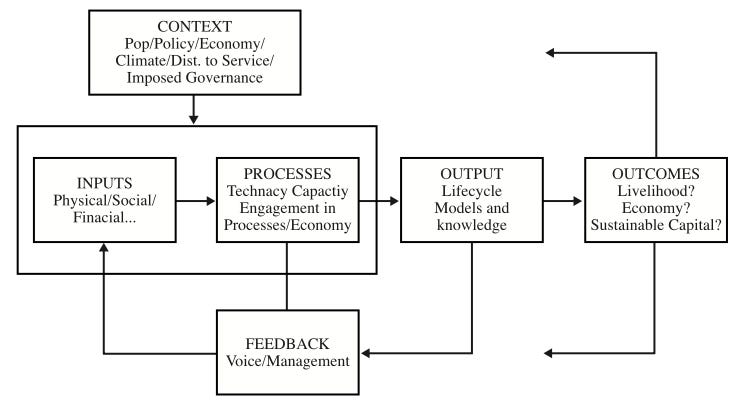
The Lifecycles Project uses a socio-technical/physical systems framework to conceptualise its data collection and theorems to manage the many elements of the research being undertaken across the team. The systems diagram (Diagram 1) below summarises the framework, based on the assumption that a more effective flow and use of all capital and capability will ultimately result in improved desert livelihoods.
The Lifecycles Project is based on the proposition that socio-cultural, educational, economic, technical and climatic factors combine to form complex cause-effect patterns that affect the life of housing and housing service effectiveness in communities. As such, The Lifecycles Project seeks to account for the main contingencies and relationships inherent in housing services (as a service cycle), quantify where possible the total lifecycle costs and lifespan impacts and distil the main ideas that would have the best chance to improve housing services for sparsely distributed desert communities.
Software Decision Tools and Models
Conventional software used to schedule the maintenance of public housing in urban, normally coastal regions of Australia was developed by the CSIRO and is currently used in the Queensland Department of Housing. (Tucker, 1996)
The objective is to identify the combination of factors and how these factors are valued to predict infrastructure and housing being extended over a number of years. Also, it is expected that the research will identify what is currently available and what can be constructed as a theoretical framework and model of what is happening in communities to identify and predict outcomes to plan out a more sustainable housing model.
In terms of the hypothesis to be tested, the question considered during the modelling stage is:
‘What are the conditions that are most likely to extend the life of housing
and other associated technologies and what impact will this have on
associated maintenance expenditure in the immediate and longer term?’
The question will be tested considering the total cost of the house properties including recurring costs, nonrecurring costs, capital costs and social costs.
Technacy Education
Whether the solution to extending the life of housing and associated amenity technologies is based on better management systems, designs or maintenance regimes, local sustainable capacity and education is most likely to be a key part of the solution’s take up rate. The goal of this key research area is to understand the gap in capacity continuity, describe its impact on the task of sustaining services in the built environment and explore improved education strategies building on concepts such as technacy education. The research describes this as a technacy gap, where technacy is a conceptual framework for understanding the capacity to think and work creatively in the field of technology. (Seemann & Talbot, 1995).
The Lifecycles team has considered how this technacy gaps connect to sustainable investment in desert communities, especially with respect to any improved software- based management tools reliant on local capacities: sophisticated tools require a sophisticated capacity to extract value. Central to this capacity is research grounded in firmly established understanding and commitment to the utilisation of technacy within the community development framework.
Local Values of Housing and Infrastructure
Another aspect of The Lifecycles Project concerns the importance of the local view of housing. Experience with housing in desert communities indicates that the living space is where two quite different value systems meet: the values embodied in the mainstream notions of house and the values expressed by desert people in their everyday usage of housing and its related infrastructure. The technology of the house, particularly the funded, standardised, codified version, has an embedded culture of funding, design, construction, usage and maintenance. For desert people, this embedded culture is not always obvious, acknowledged and valued, with substantial discontinuity in understandings of how to manage and maintain their housing (Pholeros et al., 1993).
All people act out in some way either their inherent preferences for living, whether in full control of their physical settlement environment or not. People interact with their buildings and technology by adapting to situations or manipulating situations according to inner and outer drivers. It cannot be assumed that anyone’s adaptive interaction with their buildings and technology is a fully conscious activity. Research questions are aimed at articulating desert peoples’ preferences for living well on country, commensurate with their lived behaviour.
This meeting of values is a fundamental reality, often obscured or ignored by the process of productively delivering housing units for the lowest up-front cost. The Lifecycles Project recognises that the place of intersection of these value systems is where the both the problem of existing short housing lifecycles and the opportunities for extending housing lifecycles lie.
Housing and infrastructure in Indigenous Australia is periodically evaluated for performance against a range of benchmarks and desired outcomes. Such evaluations are driven by the needs of funding agencies and their interpretation of the needs of individuals in remote communities (ANAO, 1999; Fletcher & Bridgman, 2000; Sheehan et al., 2001; Spring, 2005) They take no account of the imposed embedded values and cultures of the process of housing and infrastructure delivery.
Conventional housing and infrastructure evaluations are very clear about the limitations of direct, short-timeframe surveying methods. Consequently, a long-term process, embedded at the community level, allowing time for the deeper meanings of housing to emerge, is proposed.
A Participatory Monitoring and Evaluation (PME) methodology has been identified to facilitate storytelling to explore these issues of local values and preferences in housing and settlement development (Guijt & Gaventa, 1998). The Lifecycles Project proposes to use this participatory approach because it increases the chances of obtaining a fuller picture of what value people place on their housing; their usage behaviours; and critical events that impact on the life of housing. A suite of many specific participatory research and analysis techniques have been proposed; that is, a participatory methods tool box (Chambers, 2000; Davis-Case, 1990; Walsh & Mitchell, 2002; Wates, 2000).
The participatory process will be responsive so that methods can evolve in ways sympathetic to priorities of local people; local people will be encouraged to develop culturally appropriate research techniques.
The Lifecycles Project seeks to establish research partnerships with identified communities, because they present opportunities for mutual benefit.
Policy, Ownership Agendas and Economic Contingencies
There are two fundamental assumptions regarding the impact of a policy shift towards modes of housing and services that encourage greater private ownership and government-community partnerships. These are that:
A policy shift will extend the lifecycle of these technologies, in turn reducing costs to government and householders; and,
Technologies will provide enhanced amenity as a consequence of design, maintenance agreements and financing that accord with householder needs and capacities.
Such a policy shift also assumes the following conditions are present:
End-users have access to appropriate educational services and low income models of financing that support an owner-occupier and/or micro-financing model of housing and technical services;
Government agencies associated with housing and infrastructure programs are able to deliver flexibility with respect to community and user agreements for design, servicing and levels of financing;
Cultural perceptions of land ownership and stewardship found in desert communities can be harnessed in support of responsibility for individual and community infrastructure;
Views of men and women are brought into decision making regarding infrastructure planning, design and management;
End users and community leaders have the capacity to negotiate and honour contractual agreements.
The research proposed therefore explores the extent to which the assertion that a policy shift towards privatised desert housing and improved government-community partnerships in infrastructure service models, and the community educational demands implied, will result in extended lifecycles of technologies and technical services, and greater amenity for households could be sustained.
Results to date
Socio-technical Inputs and Process
The review and consultations on householder (social and physical) capital in housing maintenance affirmed that the repair of houses in desert communities is affected by a mix of social and technological factors (Seemann, 1997).
Two key conclusions are the needs to (i) reconsider early educational priorities in schools towards more generic problem-based learning in various technologies and (ii) rationalise services to housing sufficiently to reach a local critical mass of capability and householder tools and resources (for minor “do it yourself” household improvements).
The most substantial improvement in housing repair ratings occurred where the householder possessed a broad range of housing repair tools in a community that showed both a higher amount of ‘non-technical’ vocational expertise (such as health workers and clerks) and more semi-serviced (or transitional)1 houses.
Semi-serviced houses effectively resulted in only a few fully serviced houses needing full repair attention. That is, the semi-serviced houses were not expected to enjoy full service support, leaving more resources to be allocated to houses that had all its normal infrastructure services. The implication was that more fully serviced houses in communities were likely to increase pressures resulting in shorter lifecycles.
There are many other significant findings. Reasonable indicators for whether communities were able to sustain serviced houses were skills at social organisation, completion of non-technical vocational education qualifications, individual access to appropriate tools and a proportionally large number of semi-serviced transitional shelters.
Technical expertise was substantially under represented on communities, but where some communities had technically qualified expertise, sustainability was enhanced by the diversity of skills represented rather than any one specialist skill category; and also by a training emphasis on work organization, problem solving/ “research” skills and cross-cultural communication rather than specific repairs and maintenance (or trade-oriented) skills alone.
Technical occupations are at a disadvantage relative to teachers and health workers who had schools and health clinic centres and worked with resident professional peers (nurses, doctors, teachers) to whom they could refer. Furthermore, health and education occupations had dedicated government support with administrative centres in or near communities and stable on-going funding programs: that is, they worked under stable systems and so had stable resource flows. In contrast, industrial occupations were not operating in this context, and were very unstable.
Where government or private technical support and funding was available, it was usually supply-driven and divided along technical specialisation areas such as housing, power and water, and transport departments. Funding was risky, project-based, stop-start, and bidding-oriented from year to year, as well as not being locally based. This affected gender employment issues too - men’s work was sporadic and opportunist, whereas women’s work was steady, institutional, developmental and programmed.
Another finding was that two distinct shelter types prevailed within communities:
Light weight/local resource/temporary (implying handy-person tools), and,
Heavier/externally sourced/permanent (implying specialist tools/high level and longer training (may not be affordable)).
The temporary building materials in communities generally did not require the use of many specialised or powered tools to shape, position or transport them. In contrast, the more permanent building materials imply a more sophisticated collection of tools and equipment to construct, repair or modify them. This affects the degree of local participation in household repair and maintenance.
Software Decision Tools and Models
In order to fill out the understanding required to apply the conceptual socio-technical systems model, The Lifecycles Project has explored the use of existing lifecycle software though undertaking a review of prior research in the area of householder (social and physical) capital in housing maintenance.
The initial results of testing this software with stakeholders primarily in Central Australia, by scoping housing data and the understanding of local maintenance processes, suggests that there is inadequate quantified data to validate the model. A mind map schematic which sketches the kind of factors and their possible relationships now being explored in the design of the software decision tool (Diagram 2).
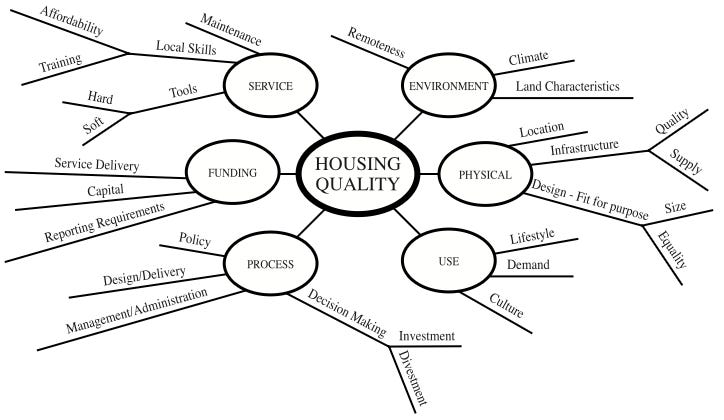
The implications of this model are that funding agencies will need to modify their data collection processes and content, and local level evaluations of lifestyles and user behaviour must be effectively incorporated.
The desktop review process also investigated other approaches and models:
function-based condition indexes and
cost-based condition indexes.
The function-based procedure requires inspection of the components of an asset and technical assessment to be made based on the ability of the component to carry out the function and provide optimal performance. This method utilises concepts like remaining-life or utility of the components to assess the condition of an asset. The cost based method does not consider the function of the component; rather it utilises a measure of the state of disrepair of a component and values the cost of returning the component to as new state. In each case the methods require assets to be broken down to component level. When a dwelling/asset/facility is broken down into its elements, it enables a more accurate assessment of its condition. The data on the specific elements needs to be accurate and the accuracy must be maintained with regular audits for the index to be accurate.
A number of indices were reviewed. The Housing Stock Condition Index (HSCI)(Tucker, 1996) has been identified as being an appropriate base index to develop. It was created by combining the condition measure for a dwelling with weightings related to each dwelling and summing the measures to provide a total. The dwelling is considered to consist of a number of components of which the cost of the required maintenance can be assessed, with the components covering all parts of the dwelling which can be repaired/replaced. This approach was the basis for the development of the Property Standard Index used by the Queensland Department of Housing to assist in the management of their property portfolio.
The research recommendation is to develop both a cost based condition index based on the HSCI and supplementarily develop a function-based index.
Local Values of Housing and Infrastructure
Community visits and follow-up discussions have occurred over the year to date with potential partner communities. These discussions have included a general overview of proposed participatory methods, the possible outcomes of the research, and return-of-service to communities. Formal letters of invitation to join in partnership with The Lifecycles Project have been sent.
Feedback about the appropriateness of tools and the overall participatory methodology has been offered by people at the community level. Through extensive consultation with a wide variety of people in remote indigenous communities, indigenous community organizations and other stakeholder groups, there has been an expression of substantial support for The Lifecycles Project and its storytelling-based participatory approach.
The offer of return-of-service for access and information has been well received and it has been contrasted against other survey-based methodologies that take, but don’t give. People are seeing that there are potential benefits for their communities in both the short and long term. This level of support at the early stage of community engagement is very positive and positions The Lifecycles Project to develop meaningful outcomes for communities, stakeholders and researchers alike. Desert people also appear to appreciate the long timeframe for the project, and that community people will not be rushed into telling their stories.
In particular, a favourable response has been received for the following: the employment of local people as Community Researchers; the involvement of Community Researchers in designing community-based activities; the use of visual-based methods; and that research activities will contribute to local people solving pressing problems in communities.
This level of support at the early stage of community engagement is very positive and positions The Lifecycles Project to develop meaningful outcomes for communities, stakeholders and researchers alike. As a result, a pilot process has been planned for the first half of 2006 in a community north of Alice Springs.
Four communities and community organizations have agreed to enter into a partnership agreement with The Lifecycles Project and will sign a Memorandum of Understanding when it has been made available by DKCRC.
Technacy Education
The Lifecycles Project has identified the need to address research in technological problem-solving as a contribution to emerging capacity development – particularly the development of generic understanding and skills in creativity and innovation for working through technological ideas and projects.
The major capacity gap in most isolated small desert community schooling occurs at two levels. At the first level, most educational services stop for most desert children after around 11 to 12 years of age, not to be re-engaged until early vocational education is considered around 16 years of age. By this time there is a very small likelihood of uptake and completion in further education. Secondly, the time spent at primary schooling in many cases barely dedicates time to fostering technacy capacities, let alone to locally interesting and engaging learning. The seriousness of this gap, in both engagement and in content, affects a community’s capacity for managing, choosing and engaging in a contemporary material culture and economy in their region.
Conclusions and Recommendations for Future Research
This paper, in reporting on the outcomes of the scoping stage of The Lifecycles Project, has identified the theoretical basis of the research, proposed key areas of research activity, commenced initial desktop and field investigations and analysed initial findings and feedback.
The results reported in this paper highlight the need for an integrated and persistent approach to technacy on communities, as well as the need for some technical research on lifecycles. However, the main thesis of the Lifecycles Project is that technical and economic considerations alone are inadequate for developing innovative responses to these needs. It is critical also to understand social factors and end user experiences and how these can affect the decisions for extending the life of housing, so as also to enhance local livelihoods. The knowledge gained from research on these matters will significantly influence housing and technical services policy, and community education policy. In addition it will provide substantial insights into changes needed in the role and structure of government extension and education services associated with infrastructure programs in desert communities, particularly in relation to understanding the systems requirements to deliver more appropriate and cost-effective technical services, education and housing technologies.
In the four key research activity areas, the following should be incorporated into the next stage of research:
Capacity development through institutional and creative delivery of technacy education, focusing initially on the critical middle schooling years normally in the range of children from 10-14 years old, to assist and explore, over the long term, the development of critical capacities in choosing, valuing, problem solving, and skilfully applying technology to meet human needs.
The extent to which a policy shift towards more private ownership of desert housing will stimulate extension of the lifecycles and costs of housing, and what preconditions in terms of training and community rights might be critical for this.
The telling of local stories of living with housing and infrastructure and the incorporation of these stories in the development of new lifecycle models.
The development of software models and trialling of these models with partner communities and government stakeholders.
The current stage of research will complete in early 2006, with the next stage being phased in over 2006.
References
ANAO. (1999). Audit Report No. 39 1998-1999 Performance Audit: National Aboriginal Health Strategy - Delivery of Housing and Infrastructure to Aboriginal and Torres Strait Islander Communities. Canberra: Australian National Audit Office, Commonwealth of Australia.
Chambers, R. (2000). Whose Reality Counts? Workshop Notes. Melbourne: IDSS Professional Development Program.
Davis-Case, D. (1990). The community’s toolbox: The idea, methods and tools forparticipatory assessment, monitoring and evaluation in community forestry. Rome:Food and Agriculture Organization of the United Nations.
Fletcher, P., & Bridgman, D. (2000). Living Spaces: An Evaluation of Housing in Remote Aboriginal Communities. Darwin: The Architect’s Studio.
Guijt, I., & Gaventa, J. (1998). Participatory Monitoring & Evaluation: Learning from Change. IDS Policy Briefing(12).
Pholeros, P., Rainow, S., & Torzillo, P. (1993). Housing For Health: Towards a Healthy Living Environment For Aboriginal Australia. Newport Beach: Healthabitat.
Seemann, K. (1997). The Socio-Technical Sustainability of Shelter Systems and Hardware in Remote Indigenous Australian Communities. Unpublished PhD, University of NSW, Sydney.
Seemann, K., & Talbot, R. (1995). Technacy: Towards a Holistic Understanding of Technology Teaching and Learning Among Aboriginal Australians. Prospects, 25(4).
Sheehan, J., Jenkins, A., & Phillips, G. (2001). The lifecycle of Indigenous housing in rural and remote areas. Canberra: Australian Institute of Health and Welfare.
Spring, F. (2005). Unpublished Review of Fixing Houses For Better Health (FHBH) and the Indigenous Housing Management System Maintenance Project (IHMSMP). Canberra: Commonwealth Department of Family and Community Services.
Tucker, S. N. (1996). Housing Stock Condition Index. AHRF Project. Melbourne: CSIRO Division of Building, Construction and Engineering.
Walsh, F., & Mitchell, P. (Eds.). (2002). Planning for Country: Cross-cultural approaches to decision-making on Aboriginal Lands. Alice Springs: Jukurrpa Books.
Wates, N. (Ed.). (2000). The Community Planning Handbook: How people can shape their cities, towns and villages in any part of the world. London: Earthscan.
Semi-serviced or transitional housing broadly refers to housing which is below current standards encompassing local-built shelters, adapted temporary accommodation, derelict houses able to deliver minimal amenity, and houses awaiting upgrades.