

Connecting meaningful learning to a culture of sustainability
Some possible pathways

Reflection
This is a paper I prepared and presented at the Spirit of Learning Conference, Byron Bay Region in September 2003.
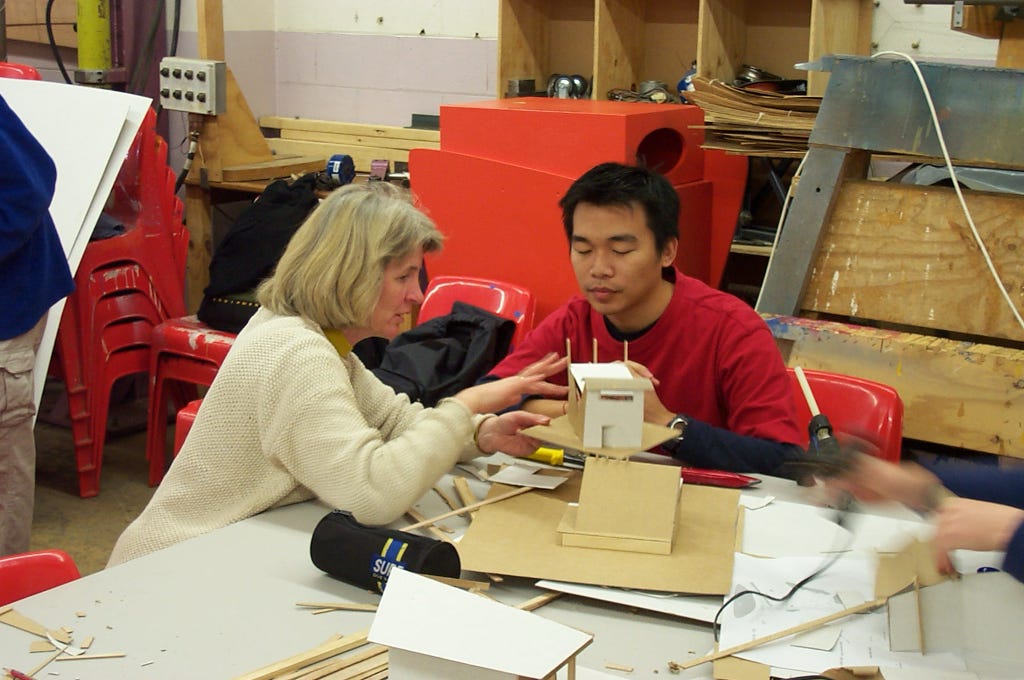
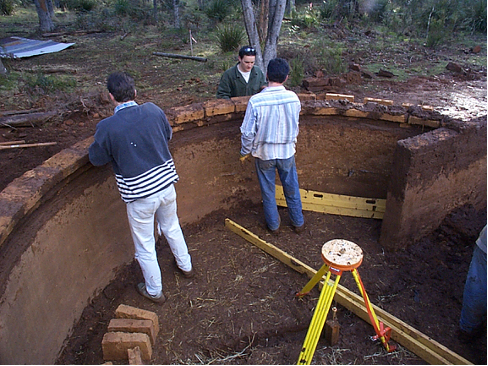
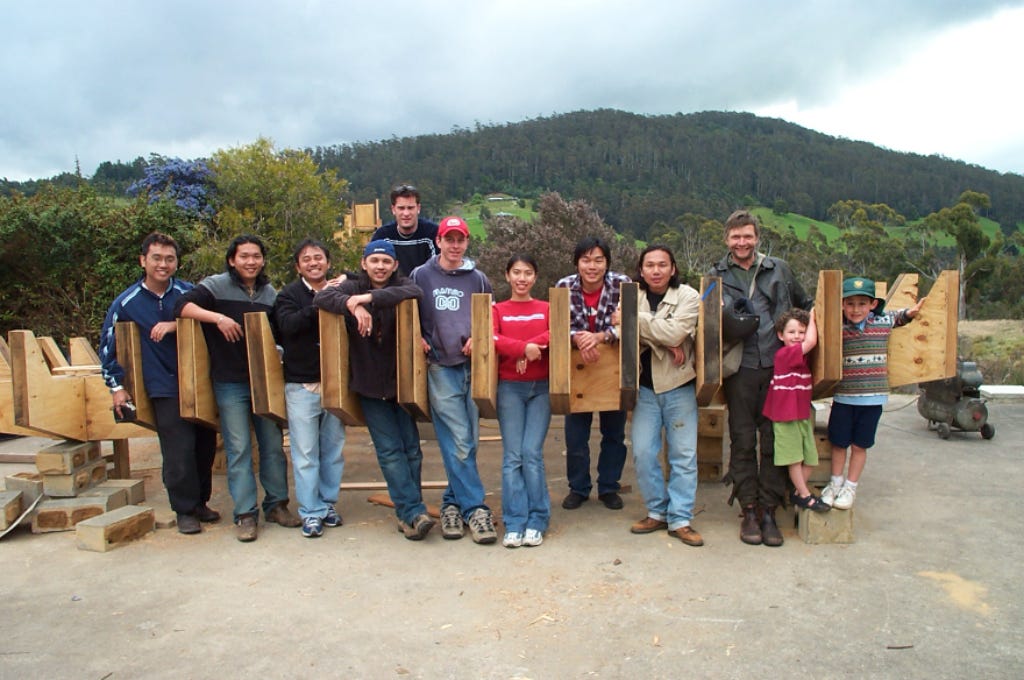
In 2000, 2001 and 2002, I was running a series of learning-by-making studios in the Architecture course at University of Tasmania. In these studios students experienced designing and building real projects in partnership with a community group in North-Eastern Tasmania.
In addition to the learning outcomes achieved by students, the studios also gave me a chance to engage in action research for my PhD studies. As with the Hidden Synergies paper, this activity helped me sketch out my ideas around the topic of meaningful learning as a dimension of developing a culture of sustainability. The paper also was an early stage draft which ultimately became the core of one of my PhD chapters.
In reflecting on this paper - and the action research experience - I re-lived all the highs and lows of these projects, as well as developed a new appreciation of what an amazing experience it was to be immersed in small, but complex, projects with multiple learning outcomes for everyone involved. This experience reinforced the importance of deep participation in supporting meaningful learning and action research.
Introduction
This paper explores the connections between meaningful ways of learning and its impact on behaviour and cultural change. It explores how these links may promote sustainability of small communities and beyond.
Sustainability is a concept (and a process) that is gaining increasing currency in many different domains. It is constantly being defined and redefined, as it matures. The most common definition comes from the Brundtland Report: Our Common Future (World Conference on Environment and Development [WCED], 1987); it is frequently recycled in most of the sustainability literature. Many environmental organizations, government organizations and corporations have their own definitions of sustainability and sustainable development.
This paper chooses not to define what is, in effect, a dynamic process other than to describe a general vision: to explore and develop ways of living which restore and protect ecosystem quality and services while improving quality of life for people; and to embed these ways in a new cultural paradigm.
Questions concerning learning and community sustainability are raised in terms of the failure of our socio-technical systems, resulting in negative ecological systems impact. There is a large, and growing, body of research and anecdotal work attesting to the adverse local and global effects arising from our socio-technical behaviours (Yencken & Williamson, 2000; Australian State of the Environment Committee, 2001; Worldwatch Institute, 2003).
In discussing communities, this paper is considering the role of the place-based physical community, because this is where we act out our behaviours, and make the majority of our ecological impacts. It is where we are most likely to reduce our ecological impacts through changed behaviour. Small communities are considered because, for the most part, we move in a human-scale world; we spend most of our time in a small number of places where we build our social relationships.
Behaviours are individual actions, but the influence of culture is represented in hidden ways. There is often a dynamic tension between behaviour and culture; but culture runs deep and can influence our (conscious and unconscious) choice of behaviour; yet behaviour change on a large enough scale, or applied at key points in our social systems can bring about culture change.
In reviewing the role of learning in sustainable development, questions are raised about the adequacy of formal education in contributing to the types of extensive behavioural and cultural changes that are needed. Such questions remain valid in terms of current formal education which implicitly or explicitly promotes ecologically sustainable development principles. Assessing whether such formal education is ecologically meaningful in terms of actual cultural change is an important task, and this paper merely represents a starting point in such an assessment.
In this paper, meaningful learning is discussed in terms of formal and informal frameworks, and their value, relative to each other and to the sustainability movement. This paper contends that, while a base of formal education potentially opens up myriad possibilities for behavioural change, it is the informal, reflective learning that arises from real-world action and experience that provides the most potential.
In the sustainability context, our communities undergo a considerable amount of education but arguably very little meaningful learning. Given that the global ecological crisis has been part of our awareness for several decades now, and that we still have not changed our behaviours much in response, it appears that we are not learning the lessons needed to move to a sustainable world. From a practical point of view, to further the movement to sustainability, learning must be considered as a completely different issue from education. Formal education is part of a paradigm that is separate from the natural cycles that we must learn to experience and understand. Formal education may also conflict with the real learning that occurs informally, especially when people are motivated to make real changes in their lives.
This is where the focus on the small community is important: there is immediacy about the effects of unsustainable behaviours; there is also immediacy about the learning opportunities that arise from these effects. Such behaviours need to be unlearned, and sustainable behaviours learned. The track record indicates that this will only occur through our direct experience: a silted up water hole; a polluted water supply; poor air quality; dramatic fuel price rises; surfing in raw sewage; release of genetically modified organisms and so on, can initiate appropriate action and the learning required to change behaviour. Change is difficult when feedback is slow, so we usually don’t act until the symptoms are obvious. Thus the real issue of learning concerns personal and community capacity building for change.
Behavioural and cultural change
The purpose in developing a new cultural paradigm is to attain an intrinsic state – a second nature - where sustainable behaviour is a part of life, a deeply informing impulse in our actions, a new social ecology. Behaviour and culture, as areas of study, are fraught with layers of meaning and many perspectives. In this paper, it is enough to name them as critical factors in a sustainable world; the key approach of this paper is to concentrate on the role of learning systems.
The deep nature of the cultural change required is problematic for formal education: we need to see changes in not only the behaviour of individuals, but of our groups, associations, organizations, companies and governments. This indicates that change is not going to come from the study of one module, or a unit, or a course or a degree. It will happen in slow cycles, building up over what Stewart Brand calls “deep time” and the “long now”(1999, p.37). Brand identifies a series of cycles that map how change occurs. There are the long cycles of nature and culture, the shorter cycles of governance and infrastructure, and the shortest cycles of commerce and fashion. Fashions change quickly, even ecologically sustainable ones. Culture changes very slowly.
In this paper it is assumed that deep cultural cycles are significant influences on behaviour. Notwithstanding this, cycles of fashion can bring about sporadic, short-lived behavioural change; it is, however, possible that some fashion cycles foster cultural change in specific domains in the short to medium term.
The implication here is that while the periods in our lives where we engage in formal learning provide the scaffolding for how we act in the world and develop our capacity for change, it is not enough to change our behaviour, which we act out over our whole lifespan. Formal education, while for some penetrates deeply, for others it is a surface thing, perhaps part of a fashion cycle: while an essential foundation, it alone is insufficient for cultural change. Informal learning links our periods of formal education; it transcends the quick fashion cycles and is fundamental for significant change over deep time.
Learning theories and sustainable development
The standard teacher education texts summarise the main theories guiding present day formal education: Piaget, Vygotsky, Bloom, Bandura, and Gardner amongst others (Woolfolk, 2001; McInerny & McInerny, 1998). These ideas focus not only on the development of children and young people, particularly in terms of syllabus-centred strategies in compulsory education; they also propose useful ideas for the discussion about the role of meaningful informal learning in the development of a sustainability culture.
Ironically, while this paper is reporting on behaviour change, it is contended that strictly behaviourist views of learning are not the most useful for deep cultural change. The behaviourist approach would represent the kind of behaviour change bought about by policy, regulation, taxes, reward and punishment. This approach has its place in the sustainability agenda, but the type of cultural change engendered by this approach is questionable: it may be shallow, fickle and begrudging. Cognitive views of learning, rather than behaviourist, may be more useful for deep time sustainability:
Cognitive theorists believe, for example, that learning is the result of our attempts to make sense of the world. To do this, we use all the mental tools at our disposal. The way we think about situations, along with our knowledge, expectations, feelings and interactions with others and the environment, influence how and what we learn.
(Woolfolk, 2001, p.240)
This view describes the type of process where people engage in self-motivated learning; it has positive implications for the meaningful. In the cognitive domain, other useful theories include: Vygotsky’s Sociocultural Theory of Development; Bruner’s Scaffolding metaphor (Woolfolk, 2001) and Bandura’s Social Learning/Social Cognitive Theory and concepts of Self-Efficacy (Bandura, 1997). These ideas stress that much learning takes place in social and cultural settings: such situated learning occurs in a process of acculturation to a community’s beliefs, values and norms; it reinforces behaviours appropriate to such a community. In the sustainability context, if acted negative environmental behaviours are representative of cultural norms, then formal education for sustainability may be of marginal value in the short to medium term. The converse may also be true: communities who have developed a sustainability culture over time tend to accelerate their learning about sustainable practices. Curitiba in Brazil (Lovins, Lovins & Hawken, 2000) and Portland in Oregon, USA (Newman & Kenworthy, 1999) are examples.
There, are, however, educational theorists whose ideas may shed some light on the value of informal learning frameworks. Dewey’s real-world views about the role of education in society (Dewey, 1997a; 1997b) have significance beyond the formal and the school setting:
What avail is it to win prescribed amounts of information about geography and history, to win ability to read and write, if in the process, the individual loses his own soul: loses his appreciation of things worth while, of the values to which these things are relative; if he loses desire to apply what he has learned and, above all, loses the ability to extract meaning from his future experiences as they occur?
(Dewey, 1997b p49)
Dewey further identifies that learning is most effective when tied to experience. Apart from the social learning aspects of this position, experience opens up further opportunities for learning, creating a spiral of deepening interest and understanding (Dewey, 1997b p37).
Dewey is critical of formal educational structures which are divorced from experience: for example the knowledge acquired in order to pass an exam, later lost and needing to be re-learnt. Education for sustainability in formal learning frameworks is flawed, if it is not grounded in experience. This learning in isolation:
….was segregated when it was acquired and hence is so disconnected from the rest of experience that it is not available under the actual conditions of life.
(Dewey, 1997b, p.48)
Some theorists and educational commentators present views highly critical of formal education. For example, Ivan Illich’s radical prescription is to eliminate formal education altogether (Illich, 1977). While this would be unrealistic and socially unacceptable, such an extremist view does help to highlight the problems with formal learning frameworks.
In a sense, these views indirectly support the idea that for meaningful learning to take place, it must connect deeply with the individual and their world-view, their aspirations and what they want to achieve through their actions in the world. Illich proposes:
The current search for new educational funnels must be reversed into the search for their institutional inverse: educational webs which heighten the opportunity for each one to transform each moment of his living into one of learning, sharing and caring.
(Illich, 1977, p.7)
While written some time ago this point of view has relevance, and seems to have predicted the informal ways of learning currently developing like wildfire on the internet.
Illich’s use of the term “educational webs” has proved highly prescient. Illich reinforces this idea with the following comment:
Most learning happens casually, and even the most intentional learning is not the result of programmed instruction.
(Illich, 1977, p.20)
Postman and Weingartner (1971) are critical of syllabus-centred learning because its primary aim is:
…..to prepare them to be docile functionaries in some bureaucracy and to prevent them from being vigorous self-directed learners
(Postman & Weingartner, 1971, p.72).
A tempering view on learning based on experience comes from Peter Senge (2001).Coming from the management paradigm, he applies systems thinking to the learning process and identifies that there is a problem with the experiential model. Experience works well when feedback is timely:
But what happens when we can no longer observe the consequences of our actions? What happens if the primary consequences of our actions are in the distant future or in a distant part of the larger system within which we operate? We each have a “learning horizon”, a breadth of vision in time and space within which we assess our effectiveness. When our actions have consequences beyond our learning horizon, it becomes impossible to learn from direct experience.
(Senge, 2001, p.23)
This systems framework indicates how difficult it is to achieve meaningful learning for individual behaviour change, let alone achieving the kind of learning needed for cultural change. This systems view of learning is especially important in gaining real outcomes in cultural change, and has great potential for connecting hard-won meaningful learning to sustainability. Bawden (2001, p.24) reinforces this idea of learning systems for “the propensity and capability for responsible collective action.”
What is meaningful learning?
Meaningful learning is a context-specific idea – both for individuals and communities. It equips people to act to achieve the things they value for themselves, their families and their communities. Meaningful learning is possible in any learning framework; Postman and Weingartner also draw on the idea of meaningful learning:
Simply said: there is no learning without a learner. And there is no meaning without a meaning maker. In order to survive in a world of rapid change, there is nothing more worth knowing, for any of us, than the continuing process of how to make viable meanings.
(Postman & Weingartner, 1971 p85)
This process of making viable meanings has significant currency for learning for a sustainable society. This is also predicated on whether individuals personally find meaning in the content of formal education for sustainability, in order to be motivated to learn what is needed for sustainability.
Formal education and capacity building
Many of our environmental problems have been created by technologies developed by people with highest levels of formal education available in Western society. This did not stop the development of technologies and associated behaviours that contribute to ecological degradation.
Formal learning is the basis of contemporary Western society; it is a broad community and social expectation, and it is legally prescribed for young people. Formal education is based on a structure of qualifications (degrees, diplomas, certificates) made up of courses, streams, units, modules, syllabus, curriculum and content. These qualifications are a form of tribal initiation into various domains; it is assumed that learning is the basis of the passage of the uninitiated into the initiated realms. Learning praxis, in formal structures, is for the most part, geared to the necessities of making that initiatory passage,not for the value of learning per se. The rhetoric behind every course, qualification and syllabus is full of the broad educational aims of study, the development of the person, the acquisition of knowledge, skills and attitudes; however, in reality, the application of course content falls below this aim: pass the exam! get the grade! higher pay! are the norms.
Formal education, because of its qualification focus, often creates very fragmented views of the world, with no crossovers between disciplines. It packages a whole area of experience, a body of knowledge, into something digestible in a relatively short time frame. Our short cycles have no room for the traditional twenty-year apprenticeship. It is due to the fragmented nature of education where the things that may be learned in formal processes are not internalised by the student: it does not have the transformative content that results in deep behaviour change.
Notwithstanding this critique of formal education, there have been significant changes in formal education structures in recent times to accommodate sustainability thinking and practice. The point of the critique of the formal in this paper is not saying, after Illich, to abandon the formal. Transformation of the formal sector is essential for better capacity development, as shown in the following examples.
In the school system, requirements to include sustainability are increasing, particularly in the sciences and Design and Technology (Board of Studies NSW, 2003). This is demonstrated by the release of a comprehensive policy on Environmental Education in NSW schools. (NSW Department of Education and Training Curriculum Support Directorate, 2001) In the Vocational Education and Training sector, nationally accredited courses such as those in renewable energy1 environmental building2, water and wastewater management3, and appropriate technology4 are appearing.
University courses in architecture, engineering5, planning, environmental studies/management are featuring substantial sustainability content. Specialist sustainable development courses are also increasing in number and popularity6. An example in the University sector is the Building Technology in Design stream of units in the School of Architecture at the University of Tasmania at Launceston: it is an example of recent national benchmarking of education for sustainability in the built environment by the Institute for Sustainable Futures at University of Technology, Sydney (Mitchell, McGee and Carew, 2002).
In a framework sense, these trends have been formalised under the heading of Environmental Education (EE) (Lucas, 1979, cited in Lang, 2003, p.2), a recognised aspect of formal school curricula, university courses and environmental learning centres; but recently, the term, Education for Sustainability (EFS) has emerged (Lang, 2003), and is being increasingly used to describe the efforts of formal education frameworks aiming for cultural change. Education for Sustainability:
….involves approaches to teaching and learning that integrate goals for conservation, social justice, appropriate development and democracy into a vision and a mission of personal and social change. It seeks to develop the kinds of civic virtues and skills that can empower all citizens and, through them our social institutions, to play leading roles in the transition to sustainability.
(Fien, 2003, cited in Lang, 2003, p.3)
It is unquestioned that formal education develops capacity in the individual, and has the potential to foster sustainability culture. Our structures of education create the foundation for learning – we learn the basics of literacy, numeracy and technacy (Seemann, 2003); we develop our abilities to research, to analyse, to synthesise, to create, to evaluate; we develop knowledge, skills and attitudes; and we do this all through pre-school, primary, secondary and tertiary education. We journey through this process with our capacity primed: to get a job, start a career, launch a business, become a social entrepreneur or even choose to do nothing much. This capacity alone does nothing, however, for the development of a sustainability culture.
Developed capacity, with its increased knowledge skills and attitudes, does not automatically lead to changed behaviour. It needs another ingredient; it needs motivation to apply the new knowledge, skills and attitudes to bring about change; it needs then to actively seek out what it needs to bring about change; it must reflect on real-world action and experience; it must be applied at key points in human systems: and this is where meaningful, motivated informal learning has most significance.
The importance of motivation in informal learning
In terms of motivation, there are many commonalities for both formal and informal learning. While formal education can equip us with the knowledge, skills and attitudes needed for sustainability, motivation may be more focused on passing the course than contributing to sustainable society. In the informal approach, the motivation to change comes before a motivation to learn what is needed to change; even though there may be periods of formal learning, the overall motivation in this case is to learn informally through a personal reflective process. Thus, such a motivated person is better placed to achieve change.
In the field of educational psychology, motivation for learning is described in a theoretical framework of expression, approaches, goals and self-schemas (Woolfolk, 2001; McInerny and McInerny, 1998). Motivation can be expressed as intrinsic or extrinsic, that is, from personal interest or outside influence. People can be partially motivated in both ways; or they can move from extrinsic to intrinsic motivation as a learning process progresses.
Intrinsic or extrinsic expression of motivation can play out through four general approaches: behavioural (rewards and incentives); humanistic (need for self-actualisation and self-determination); cognitive (thinking, making plans, developing goals, interpreting and responding to events); and socio-cultural (participation in the life of the community/communities of practice).
These theoretical motivation frameworks also describe the behaviour of learners as being goal-directed, with four broad kinds of goal: learning goals (knowledge/skill/task-centred); performance goals (demonstration to others/ego-driven); work avoidance goals (participation is highly conditional); social goals (extension to social relationships beyond task).
Self-schemas, or beliefs about one’s ability, also play out in the motivation mix, particularly if from an incremental perspective where the belief is based on the possibility of increasing ability through learning and experience.
It should be noted that these motivational frameworks do not fully describe the whole learning process as dynamic and changing. People move through the motivation framework as their motivation responds to a changing range of intrinsic and extrinsic factors. For motivation to provide the missing ingredient, it must be closer to the humanistic and socio-cultural, with learning and social goals uppermost.
Some possible pathways
Some of the better thinking in the connection of meaningful learning and sustainability is coming from researchers, facilitators and extension workers in regional Australia. A recent publication from the Centre for Research and Learning in Regional Australia at the University of Tasmania (Falk, 2001) highlights a study of learning, cultural change and sustainability amongst pastoralists in the tropical savannahs of northern Australia (Arnott & Benson, 2001). The study showed that pastoralists engaged in cultural change by a combination of place- and situation-specific processes embedded in a network of relationships with other pastoralists, extension services and educators. Timeframes were important: pastoralists motivated to change constantly chose to do so in their own time. It also demonstrated that pastoralists gained their motivation and knowledge through largely informal means, based on their own diagnosis of their own contexts. They also accessed formal education when they deemed it necessary.
There are many other exemplars showing how informal ways of learning that could help us to “care for country” and to connect us, and our behaviours, to the needs of local ecologies. Much work in developing countries, in remote indigenous communities and in the mainstream has been based on a meaningful learning approach.
Community-based Landcare groups (including Coastcare, Rivercare, Bushcare and Wildcare) have demonstrated how much cultural change can be achieved in land management practices through a highly motivated, informal learning approach (Landcare Australia, 2001, p.12).
Settlement planning projects in Indigenous communities incorporate learning processes to further develop the capacity of community members to make decisions about their long-term future on country, and to take action to make their visions a sustainable reality. A community in North Queensland engaged in an intensive planning project over a three-month period, followed up by regular workshops to focus on specific areas. (Centre For Appropriate Technology, 1997; Mona Mona Community, Djabugay Tribal Aboriginal Corporation & Centre For Appropriate Technology, 1999) The planning process was essentially learning-based; people needed to learn that they can make their own decisions about their communities future, and more importantly learn the strategies for successful decisionmaking.
Another planning process example in the east Kimberley region of Western Australia, responded to an existing motivation for change where there were strong views about what was needed to ensure a viable, sustainable community. The project was structured to facilitate the community’s own decision-making (Anda, Yuen, Calais & Revell, 2001).
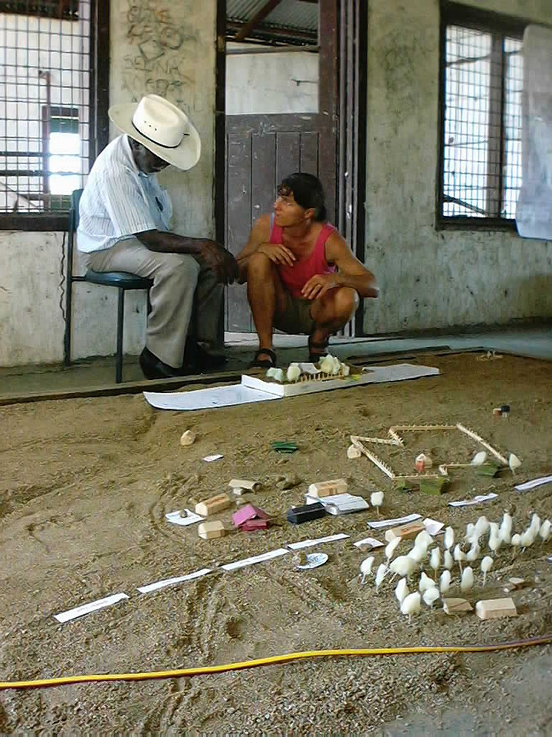
There is a growing body of experience of participatory development projects in remote Indigenous communities, demonstrating how informal learning can contribute to cultural change. Haar (2003) describes a self-build project in the Torres Strait Islands in the late 1980’s and early 1990’s, where the learning, though facilitated, was essentially informal; the project fostered substantial individual and community change, although political realities of land tenure and national politics has since stifled progress. Scally (2003) describes a successful approach where a mix of formal and informal learning structures has bought about significant development of outstations in the Top End of the Northern Territory. In a participatory project report, the author (Parnell, 1995) describes how an informal learning process on a real, locally valued project bought about change in a small outstation community in Central Australia.
Another example is a long-term slum community redevelopment project in India where sustainable development is a key goal. Learning has been built into the process, including the production of a planning handbook developed to record and reflect the long term aspirations of the community and to ensure the path to sustainability is followed (Burnham, 2002). The project is unfolding over a ten-year time frame to better foster change to a sustainability culture.
Conclusions: connecting meaningful learning to a culture of sustainability
An ethos of active and self-directed learning is the only way in which individuals and society can manage change in an inclusive and equitable fashion.
(Kingma & Falk, 2001, p.241)
Much of the ideas and contentions in this paper about learning and cultural change, arise from the author’s reflections on experience as both a learner and educator in formal and informal learning frameworks and in community development.
Where we currently stand is at a point where a sustainability culture is a long way short of being intrinsic, a second nature. Learning will be part of the process of achieving that second nature. It is crucial for us to understand: how and why we learn what we need to know; and how to connect what we learn to facilitate changing our culture from the ecologically destructive to the restorative. We must also maintain awareness of Senge’s (2001) warnings about the importance of time lags in feedback in our learning systems; it is ironic that this parallels the slowness of feedback from ecological systems.
When it comes to actively seeking change, the author believes that an informal approach to learning, on a foundation of developed capacity, applied in meaningful ways, in real-world actions and with a high level of motivation, is essential to create a culture of sustainability over deep time.
References
Arnott, A. & Benson, R. (2001) Learning, Change and Sustainability: Exploring the learning processes of pastoralist stakeholders in the tropical savannas, in Falk, I.(Ed.) Learning to Manage Change: Developing regional communities for a local-global millennium. (pp.177-181) Adelaide: National Centre for Vocational Education Research.
Anda, M., Yuen, E., Calais, P. & Revell, G. (2001). Gelalba Nawarrangim: Community+ Settlement + Country – Phase 2 Report: Cultural Inventory & Analysis. Perth: Murdoch University/University of Western Australia.
Australian State of the Environment Committee. (2001). Australia: State of the Environment 2001. Melbourne: CSIRO Publishing.
Bandura, A. (1997). Self-Efficacy: The Experience of Control. New York: W.H. Freeman.
Bawden, R. (2001). Life Beyond Economics: Learning Systems and Social, in Falk, I.(Ed.) Learning to Manage Change: Developing regional communities for a local-global millennium. (pp.23-30) Adelaide: National Centre for Vocational Education Research.
Board of Studies NSW. (2003). Design and Technology Syllabus Years 7-10. Sydney: Board of Studies.
Brand, S. (1999). The Clock of the Long Now: Time and Responsibility London: Phoenix
Burnham, R. (2002). Community Action Planning: Processes, Ideas and Experiences. Mumbai: YUVA
Centre For Appropriate Technology Inc. (1997). Mona Mona: Working Together for a Healthy Community: Feasibility Study Main Report. Cairns: Centre For Appropriate Technology
Dewey, J. (1997a). Democracy and Education: An Introduction to the Philosophy of Education. New York: The Free Press.
Dewey, J. (1997b). Experience and Education. New York: Touchstone.
Falk, I. (Ed.) Learning to Manage Change: Developing regional communities for a local-global millennium. Adelaide: National Centre for Vocational Education Research.
Haar, P. (2003). Community Building and Housing Process: Context for Self-Help Housing, in Memmot, P. Ed. Take 2: Housing Design in Indigenous Australia. Canberra: The Royal Australian Institute of Architects.
Hawken, P., Lovins, A., & Lovins, L.H. (1999). Natural Capitalism: Creating the Next Industrial Revolution. Boston: Little, Brown and Co.
Illich, I. (1977) Deschooling Society. Harmondsworth: Penguin Books.
Kingma, O. & Falk, I. (2001) Learning to manage change in communities: a way forward, in Falk, I. (Ed.) Learning to Manage Change: Developing regional communities for a local-global millennium. (pp.231-241) Adelaide: National Centre for Vocational Education Research.
Landcare Australia Ltd. (2001) Landcare Australia Limited Annual Report 2001. Sydney: Author
Lang, J. (2003). The Australian Association for Environmental Education Report to the Review Committee of the Commonwealth Review of Teaching and Teacher Education. Melbourne: Australian Association of Environmental Education
McInerny, D.M. & McInerny, V. (1998). Educational Psychology: Constructing Learning. (2nd Ed.) Sydney: Prentice Hall.
Mitchell,C., McGee, C. & Carew, A. (2002). Training in the Building and Construction Industry: Stage II Final Report. Sydney: Institute for Sustainable Futures.
Mona Mona Community, Djabugay Tribal Aboriginal Corporation & Centre For Appropriate Technology Inc. (1999) Mona Mona: Working Together for a Healthy Community – Picture Summary. Cairns: Centre For AppropriateTechnology.
NSW Department of Education and Training Curriculum Support Directorate. (2001) Environmental education policy for schools. Sydney: NSW Department ofEducation and Training.
Newman, P. & Kenworthy, J. (1999). Cities and Sustainability: Overcoming Automobile Dependence. Washington: Island Press.
Parnell, M. (1995) Mulga Bore Shelter Relocation Project. Alice Springs: Centre For Appropriate Technology.
Postman, N. & Weingartner, C. (1971). Teaching as a Subversive Activity. London: Pitman Publishing.
Scally, S. (2003). Outstation Design – Lessons from Bawinanga Aboriginal Corporation in Arnhem Land, in Memmot, P. Ed. Take 2: Housing Design in Indigenous Australia. Canberra: The Royal Australian Institute of Architects.
Seemann, K. (2003). Basic Principles in Holistic Technology Education. [Online article]. Journal of Technology Education 14(2).
Senge, P. (2001) The Fifth Discipline: The Art and Practice of the Learning Organisation. Sydney: Random House.
Woolfolk, A. (2001). Educational Psychology. (8th Ed.) Boston: Allyn and Bacon
World Conference on Environment and Development. (1987). Our Common Future. Oxford: Oxford University Press.
Worldwatch Institute. (2003) State of the World 2003. Washington: Author.
Yencken, D. & Wilkinson, D. (2000). Resetting the Compass: Australia’s Journey Towards Sustainability. Melbourne: CSIRO Publishing.
Certificate IV in Renewable Energy Technologies
Certificate IV in Environmental Building Principles
Water Industry Training Package
Certificate I, II & III in Applied Design and Technology (The Aboriginal Technical Worker Program); for remote Indigenous communities through the Centre for Appropriate Technology in Alice Springs, NT.
Engineering for Sustainability at University of Technology Sydney
Courses in sustainable development through Institute of Sustainability and Technology Policy at Murdoch University, and the Institute for Sustainable Futures at University of Technology, Sydney.